The software factory
· AI
On 15 November 2025 I got on stage in Porto and talked about using Cursor as the place work happens. Ticket in, branch out, docs and PR without living in five tabs. That day is why this site exists. The talk writeup was the first real post.
A year later the interesting unit is no longer a completion in my buffer. It is an agent that can run until something is true. This is the comparison: what that Cursor workflow was, what a software factory mentality means, the picture Gergely Orosz drew of OpenAI’s loop, and the smaller factory I actually run.
Then: Cursor as the place work happens
In November 2025 the pitch was simple. Stop treating the model like a second monitor. Put it in the editor. Give it rules so it sounds like you. Wire Jira, Notion, and GitHub through MCP so you are not the paste layer.
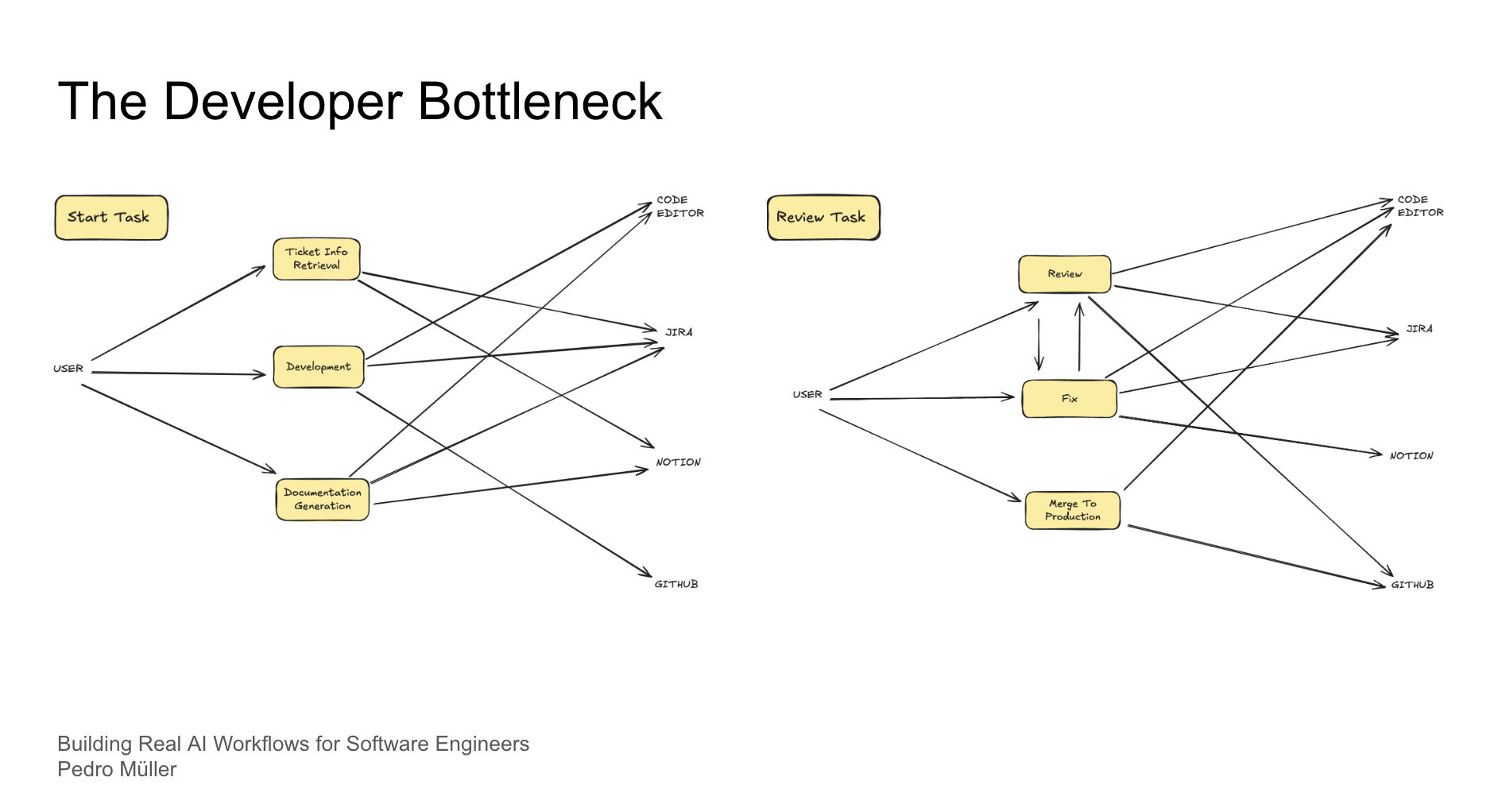
I published that setup as ai-workflow-cursor-config. It worked. I got faster. Busywork left the browser. I still reviewed every line. The model wrote. I owned the diff.
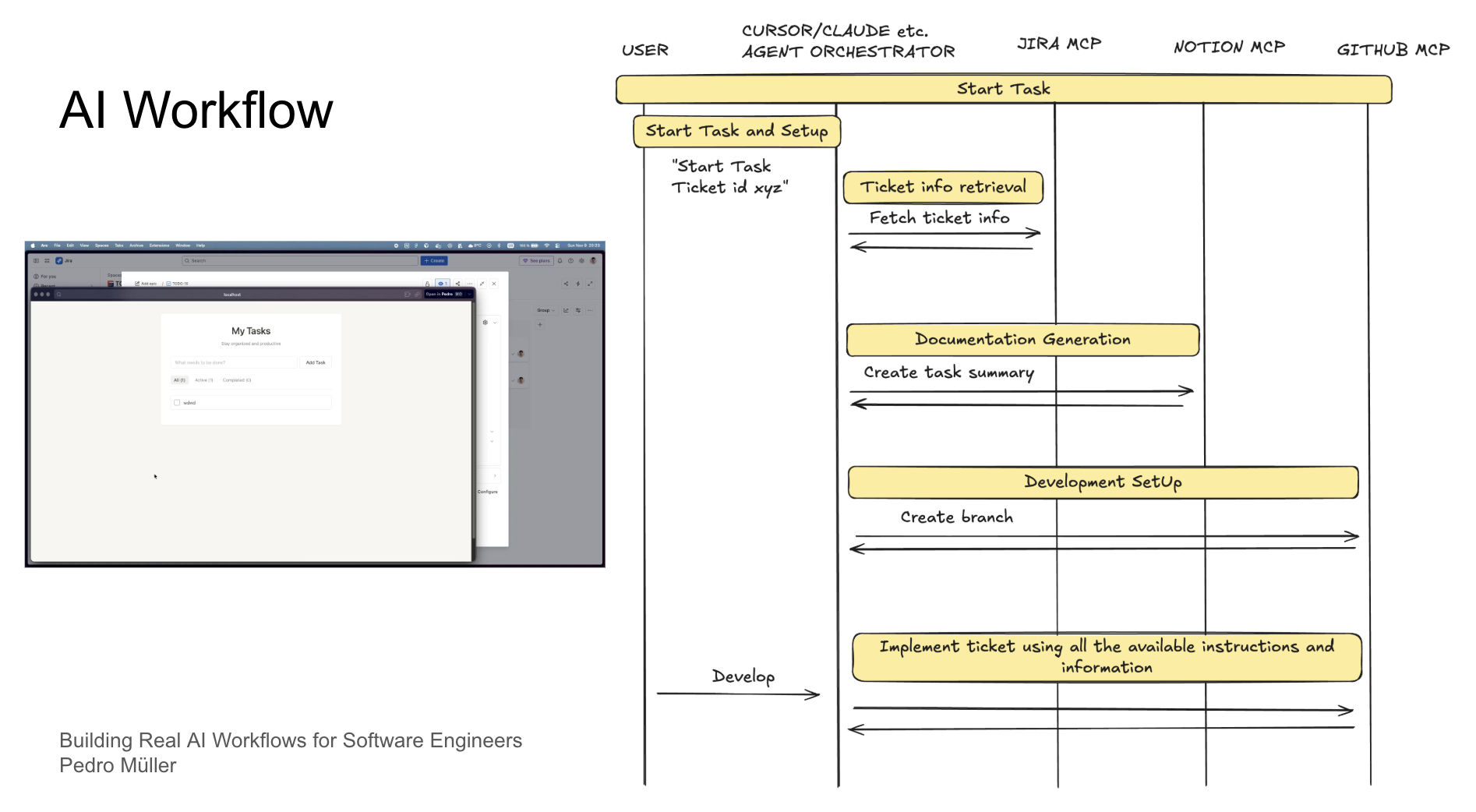
sequenceDiagram
  participant U as Me
  participant A as Cursor agent
  participant J as Jira MCP
  participant N as Notion MCP
  participant G as GitHub

  U->>A: Start task ticket XYZ
  A->>J: Fetch ticket
  A->>N: Draft docs
  A->>G: Open branch
  U->>A: Develop and review every line
  A->>G: Push and open PR
That felt like the endgame for a while. A better IDE loop. Same job, fewer context switches.
It was the on-ramp.
The software factory mentality
The year did not feel like one leap. The floor kept moving under the same question: where does the human sit in the loop?
A software factory is not “the model writes faster.” It is a pipeline where agents can finish work in an environment that survives a session, and humans sit at the forks that still need taste: what to build, what risk is acceptable, when to stop the line.
The mentality, for me, is a few bets:
- Outcome over keystrokes. I specify what must be true when we are done. The crew figures out the files.
- Harness over heroics. Rules, tools, CI, worktrees, and a place to see who is blocked matter more than a clever prompt.
- Risk as routing. Not every PR deserves the same eyes. Low-risk can move on policy. High-risk still needs a person.
- Feedback that closes. Green CI, review comments, staging, production signals. The loop continues after the first push.
- Accountability stays human. Tools made me faster. They did not make me less responsible for the merge.
Cursor stayed useful. Rules and MCP are still the right idea. The center of gravity shifted from “AI in the editor” to “an environment that can finish work while I am elsewhere.”
Along the way I built pieces of that harness. Conduit so a session keeps going when a plan quota dies. Jev as a typed fork for auto-merge, human review, or agentic deploy. Homelab work with OpenClaw taught the same lesson in a smaller room. The model is the engine. The environment around it is the product.
The picture from the Pragmatic Engineer
Gergely Orosz’s writeup of OpenAI’s agentic software factory is the clearest public diagram of the shape. Human defines the outcome. Codex gathers context, implements, babysits CI, takes specialist agent review, routes on risk, and after a human allows production, another agent handholds the rollout. Perf Factory and Sevbot feed production back into the next loop.
I am not OpenAI. I do not have a Perf Factory or a Sevbot. The transferable bit is the pipeline, and the fact that risk is a routing problem. If every PR still needs a human staring at every line, the factory just moves the queue.
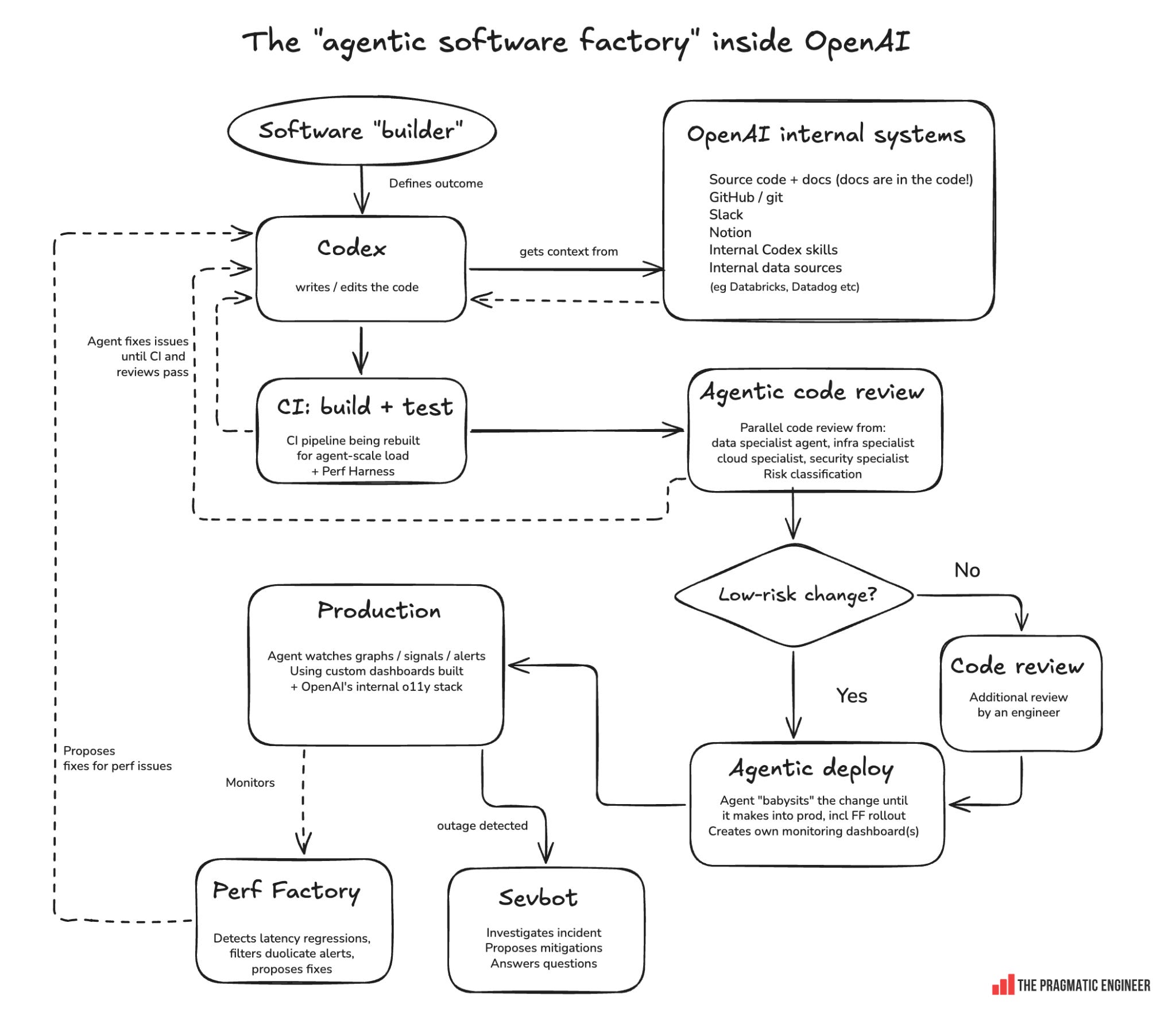
That diagram is the north star a lot of us are pointing at. Mine is smaller, messier, and personal. Same mentality. Different tooling.
How I run it: Firstmate and Herdr
I do not spend most of my coding hours staring at an editor the way I did a year ago.
Now I talk to one agent: the first mate. It runs a crew. Each crewmate gets its own session and a clean git worktree. They ship PRs, merge when I have already approved the policy, or come back with an investigation. I am not tabbing through five half-finished chats hoping nothing collided.
Herdr is where those agents live. Real terminals. Working, idle, blocked. I can leave. They keep going. I come back and see who needs me instead of hunting panes. Firstmate on Herdr is the combo that stuck for me: one conversation at the top, a visible herd underneath.
The workflow is “give the first mate an outcome, let the crew take the repo apart in parallel, and show up when something is stuck or ready.”
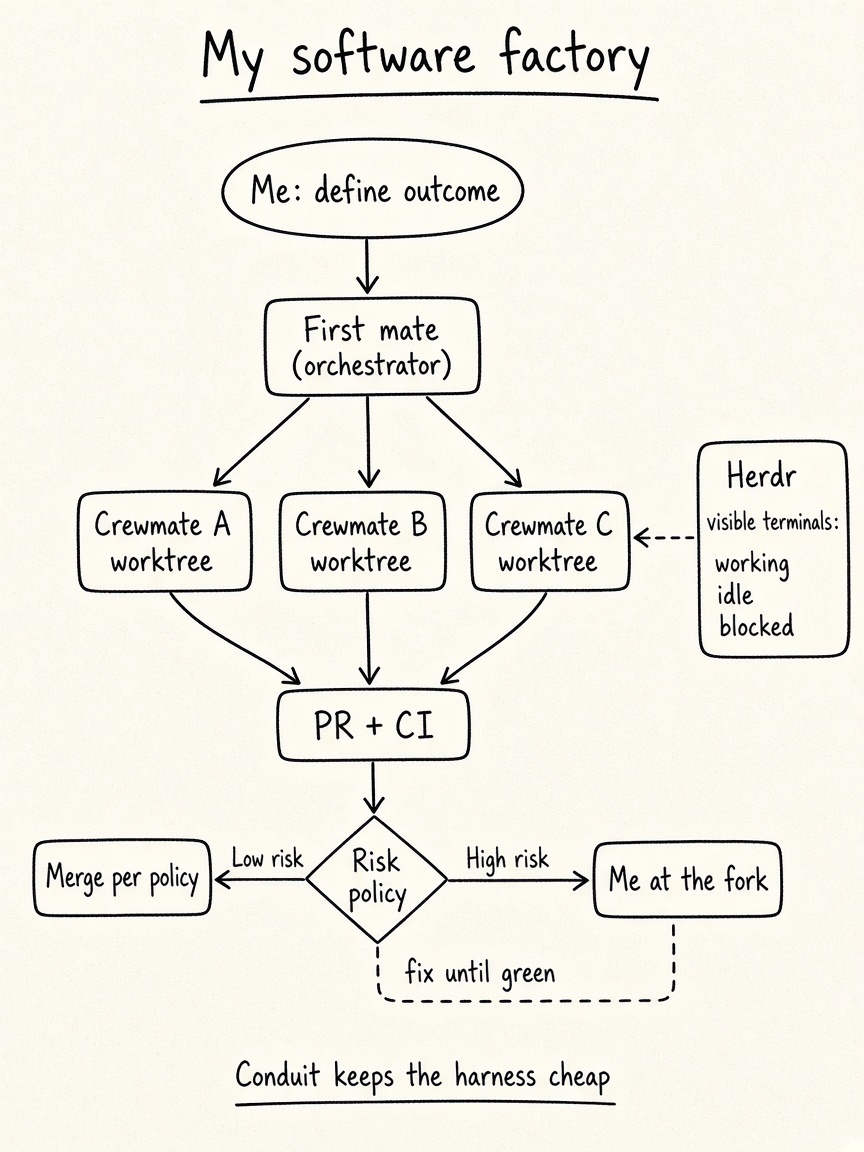
And the same shape as Mermaid, so it stays editable with the post:
flowchart TD
  Me["Me: define the outcome"] --> FM[First mate]
  FM --> C1[Crewmate A / worktree]
  FM --> C2[Crewmate B / worktree]
  FM --> C3[Crewmate C / worktree]
  Herdr["Herdr: working / idle / blocked"] -.-> C1
  Herdr -.-> C2
  Herdr -.-> C3
  C1 --> PR[PR + CI]
  C2 --> PR
  C3 --> PR
  PR -->|fix until green| C1
  PR -->|fix until green| C2
  PR -->|fix until green| C3
  PR --> Risk{Risk / policy}
  Risk -->|low risk, policy ok| Merge[Merge]
  Risk -->|high risk or stuck| Fork[Me at the fork]
  Fork --> Me
  Merge --> Me
That sounds like marketing until you feel the hours. The hours feel different.
Side by side
| A year ago (Cursor) | Now (factory) | |
|---|---|---|
| Unit of work | One chat in one editor | Outcome → crew of worktrees |
| Where I sit | Inside the diff | At the fork: brief, policy, unblock |
| Context | Rules + MCP in the IDE | Harness that survives sessions |
| Parallelism | Me serial, maybe two tabs | Several crewmates, visible on Herdr |
| “Done” | I read the PR and merge | Tests, CI, policy; I read when risk is real |
| Merge | Always me | Me, or policy I already set |
I do not look at the code the same way
I still can. I still do, when the risk is real. Auth, money, data deletion, anything that can wake someone up at 3am. That did not get softer.
What got softer is the default. Most of the time I am not reading the diff line by line. I am reading the brief, the tests, the PR description, the CI, the thing the agent claims it verified. I am judging whether the shape is right. Whether I would bet on this change in production. Whether the harness caught the dumb mistakes so I do not have to.
A year ago that would have sounded negligent. Now it sounds like the only way the loop stays human-sized when the crew is writing faster than I can scroll.
The uncomfortable truth: for a lot of work, looking at every line is theater. You feel responsible because your eyes moved. You are not actually holding the system. Tests, types, review agents, staging, and a clear merge policy hold more of it than another pass of “looks fine.”
The care moved. Spec. Constraints. Eval. Rollback. Who is allowed to merge. What “done” means before anyone opens an editor.
The code is still there. I am not the primary reader anymore.
The part that worries me
I do not want to pretend this is only upside.
Skill atrophy is real. If I stop reading code, I get worse at reading code. The day something weird breaks in production, “the agent will figure it out” is not a personality. It is a bet. Some weeks I force myself into the files on purpose, the way you stay in the gym when the elevator works.
Junior paths get muddy. I learned by staring at bad diffs and writing worse ones. If the default path is “describe the outcome and accept the PR,” who builds the taste that tells you the outcome was wrong? I do not have a clean answer. “The seniors will review” does not scale if the seniors also stopped looking.
Accountability does not move with the cursor. If a change ships and hurts someone, nobody cares that a crewmate wrote it. My name is still on the merge. Tools made me faster. They did not make me less responsible.
The job title is sliding. “Software engineer” used to mean I produced the text. Now a lot of days I produce judgment, sequencing, and taste. That is still engineering. It is also easier to fake. Confidence without contact with the metal is a failure mode I watch for in myself.
The industry will overcorrect twice. Once toward “AI wrote it, ship it.” Once toward “AI is fake, go back.” Both are lazy. The hard middle is building harnesses that make judgment cheap and mistakes expensive.
The part that makes me optimistic anyway
I am more useful than I was a year ago. More of my time sits on the decisions that actually mattered then too: what to build, what to refuse, what “good” means, how to recover when we were wrong.
The boring tax shrank. Tab juggling shrank. Waiting on myself to remember the Jira description shrank. The year of Cursor rules, MCP, Conduit, decision layers, and now a crew on Herdr all point the same direction: put the model in an environment that can finish work, and keep the human at the fork.
I still like building. That did not leave. What left is the romance of being the only hands on the keyboard. That romance was always a bit about ego.
Porto was me saying: this is already how I work, here is the template. A year later the template looks small. The work moved from “AI in the editor” to “a herd that ships while I sleep, and a first mate I talk to when I wake up.”
Two pieces of that year are still drafts on my desk: how it feels when the model holds the map of the code and I hold the outcome, and how a team should write decisions and specs so the map survives the session. Those come next.
I am uneasy about the parts above. I am also excited. Uneasy and excited at the same time is usually the signal I am in the right decade.
Views here are still my own. Same as hello world.
See you in the next loop.